Why I’ve Chosen to Indie Publish My Novel

Indie music, Indie video games, Indie publishing. It’s all the rage, haven’t you heard?

I’ve been a nerd/geek for as long as I can remember. Being trendy has never been an aspiration of mine. I’m very independent.

Hence, Independent publishing.

Thanks to Amazon, the ebook revolution is well underway, and now authors have a new and inexpensive way to reach readers, and maybe some can even make a living out of it.

My reasons for choosing to go Indie with By the Light of the Moons are the following:

  1. Royalties: Let’s just get this one out of the way first since it’s a no-brainer. 70% royalty per ebook paid once a month when Indie, vs. 10-15% per book paid 1 or 2 times a year when with a publisher? No contest.
  2. Marketing: Wait, what? Don’t Indies have to market their books themselves? Yes, but so do first-time authors going traditional publishing–and for substantially less money for their effort, too. If I’m going to have to do it anyway, might as well make more money. And do it my way. Which leads me to…
  3. Control: I choose everything. The cover, the title, the blurb, the layout, the ebook formats available, the marketing, and most important the price are all controlled by me. For the perfectionist, this is heaven.
  4. Ownership: If I chose to publish with a traditional publisher, I would have to sell my rights to the book to them. Indie publishers retain their intellectual property.
  5. Speed: Indie publishers can get their books out instantly. Legacy publishing can take 1 to 2 years to print and get in stores.
  6. Sold Forever: Legacy publishing is cruel; if you don’t start selling within a few weeks, your books are pulled off shelves. With ebook indie publishing, everyone shares the same web real estate, and a book is only pulled if I want it to be.
  7. Freedom: For the first time, writers are now able to be the artists they truly are. Think about all the other professions of art: painters, sculptors, jewelry makers, soap makers… you name it, they have the freedom to create, produce, market and sell, all on their own. Sure, it’s hard. But they have the freedom to try, and succeed or fail by their own merit. They’re not held back by the enormous power that publishing companies have to deem which writers are worthy of print. And now, the writers are free, too.

Despite all the above, there is still that little part of me (the one that wants recognition and prestige) that wonders, “Could I have made it the traditional way?”  I don’t know.

But  really,who cares? Why should a person I’ve never met get to decide if my book is “worthy” of print? Let the reading market decide if I’m worthy.

Independence. It is here. It is now. Savor it.

Robin

Life Happens, and the Novel Continues

Since my last post, a lot has happened.

Most important news: this guy showed up:

Robin

Robin

So naturally he takes up a lot of my time. (He’s so darn cute, how could he NOT?)

On the novel-front, I asked 30 people to become beta readers of my novel’s 3rd draft. Of those, 22 agreed to read it and provide feedback within 45 days.  I extended it to 60 days, with 13 coming through for me with some great feedback.

Draft four took me a month to incorporate some fantastic suggestions and even some copy editing (thanks Gramma!).  Around early June I had completed the 4th draft.

Then it was time to take the biggest step of all: I hired a professional editor.  It cost me a hefty sum, but it was well worth it. I plan to discuss this in more detail in a later post, but suffice it to say it was not entirely what I expected – but that wasn’t a bad thing. I learned a lot.

So there’s no turning back now. I have to sell books to make that editing fee back.

No worries.

Now that I have the edited manuscript back in my hands, I am working on the 5th and final draft of my first novel. At the same time I am learning as much as I can about marketing independent published books while also reading up on Amazon Kindle Direct Publishing and Smashwords publishing.

I hope to release my novel in the early fall. Stay tuned!

How I Wrote a Novel, Part Five

(continued from part one, part two, part three, and part four)

This is the final part of my series, and it concerns the revision phase.

Once I knew I was going to finish the initial draft of my novel, I also knew there would be many more drafts to follow. It wasn’t just because everything I read about writing said this would happen. I knew it instinctively, because I know myself – perfectionistic, detail-oriented, I couldn’t rest with just one pass through. On the other hand, I also had to limit myself, because I knew I could probably keep going and going and drive myself crazy.

Thus, my plan had always been:

  • Draft 1: The initial draft, get the story out on the screen and finish it
  • Draft 2: Make the story cohesive, thematic, consistent; cut what no longer fits (think: 20 grit sandpaper)
  • Draft 3: Polish the prose; read the story in one sitting to create a proper flow
  • Beta reader phase: let friends and family read the whole thing and offer constructive criticism
  • Final Draft: Incorporate suggestions I agree with from beta reader phase.

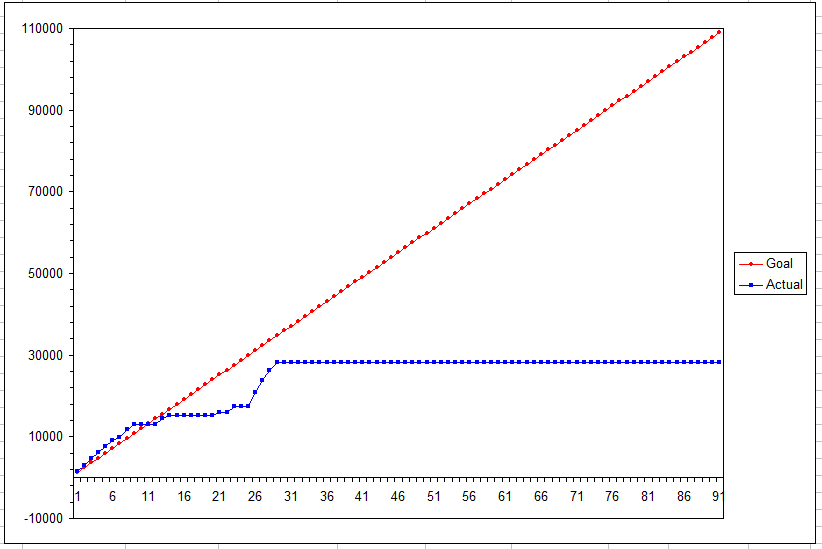
And that is pretty much just how it has happened. Draft 2 was very difficult for me. I had hoped to finish all the above in three months’ time. Here is how Draft 2 worked out over those 3 months:

Poor motivation to revise

Yep, failed again. I chickened out on stickk this time, so maybe that had a part to play in it. Since the first half of the book was so different from the second half, I had to reread carefully to make sure I got rid of the old thematic stuff and seeded with new thematic stuff as I went along. I also kept Stephen King’s suggestion in the back of my head: “2nd draft = 1st draft minus 10%”. In the end, draft 2 was exactly that.

But how did I do that? Well, it was my son. You see, today is his due date; we’re expecting him to be born any day now. And I wanted to get draft 3 done and in the hands of beta readers before he was born. Then that would give them all a month or so to read it, and I could spend time with my family. I finally had the motivation I needed for the last big push. January was the hardest, getting through 3/4 of the book in one month.

Now THAT's revising!

Success, draft 2 was complete, and it was 10% smaller. And yet it really wasn’t as hard as I thought it would be. Not trying to sound arrogant here, honestly, but the evidence is clear: I am capable of doing quite a lot when properly motivated. So I re-learned something about myself these last 16 months: with the pressure of a definitive goal I can do great things. (Let’s see if I can solidify that in my mind and finish the next book, start to finish, in half that time.)

The first weekend in February I printed all 350 pages and read the whole thing in one sitting with a red pen in hand. Took another 2 weeks to put those edits in, and it got smaller still. Draft 1 was 109,000 words, Draft 3 was 96,000. During the last week of February I formatted everything and sent it out to the beta readers before March 1. And that is where it stands now.

So there you have it, how I wrote a novel in 16 months. Hopefully you yourself will be able to read it soon. I’m really considering ebook self-publishing, despite the prestige a “real” published work could bring. The always controversial Joe Konrath has some pretty convincing advice about this, so I’ll have to see what my beta-readers think. However I publish – and I WILL PUBLISH – I’ll be sure to let you watch the journey right here.

I hope you don’t feel cheated now that you’ve reached the end of the series. After all, the series was called “How I Wrote a Novel”, not how I published one. But I’m just as interested in that part of the story as you are. Stick around and watch me do it.

How I Wrote a Novel, Part Four

(continued from part one, part two, and part three)

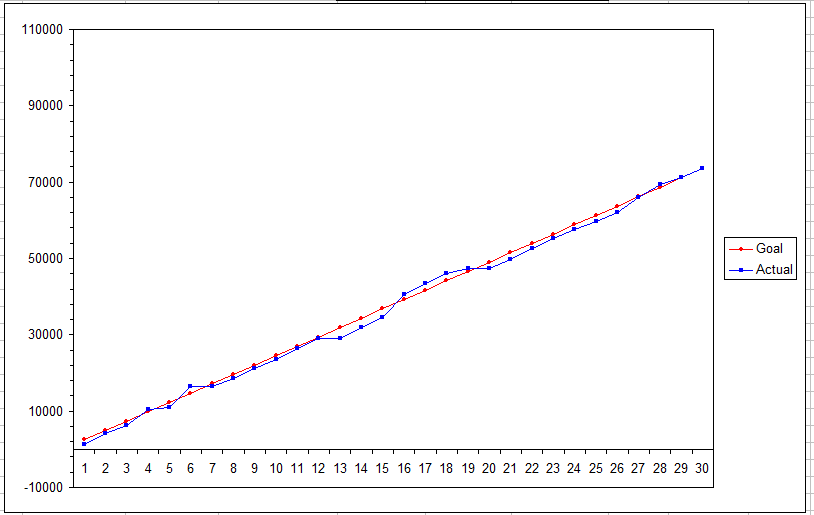
Before talking about the revision period, I wanted to get into a little more detail of how I finished the second half of my book. One of the things that I struggled with after the big marathon was finding the proper motivation. What, finishing the novel wasn’t enough? Apparently not. Watching my chart during November, knowing I was getting closer and closer to 50,000 words with each passing day, was a great motivator. But come January, the motivation was gone.

What was the problem? Well, burn out for starters, as can be expected. But after taking December off, that wasn’t an excuse anymore. Next problem? Well, there was the fact that I wasn’t really sure how long this thing was going to get. 100,000 words? 150,000 words? And how long would I take to finish it? Another marathon month? Two?

I figured I needed another nerdy chart to watch my progress, but with a wife and one year old at home, I didn’t want to put them through another crazy month. So I came up with a goal of another 50,000 words by the end of March. 50,000 words in THREE months? That meant I only had to work 1/3 as hard as last time! Easy!

Nope. By February I saw the goal slipping so I moved the end date to the end of April. Result:

Goal unmet

Pathetic. But you’ll notice I picked up some steam at the end there. What happened?

stickk happened.

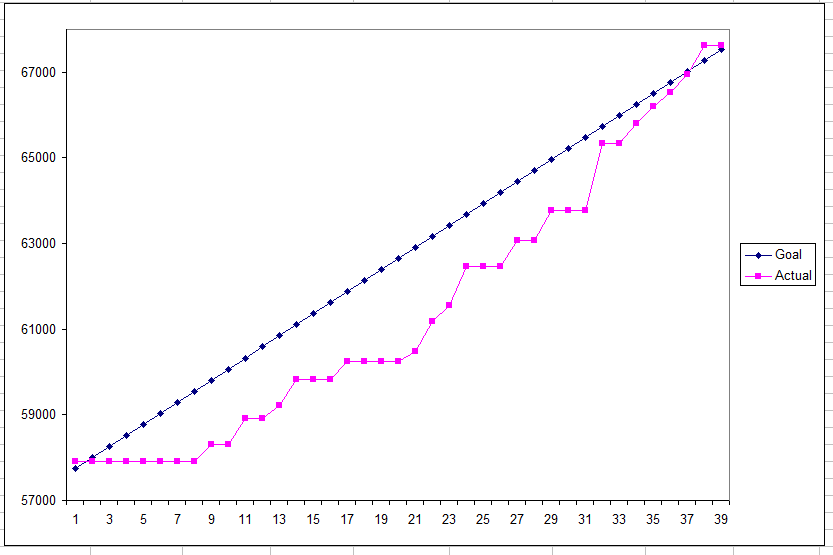
I would not have started a novel without NaNoWriMo, but I would not have finished my novel if it weren’t for stickk. I highly recommend stickk for anyone who wants to “stick to a goal” (get it?). I chose a method that worked very well for me, and I called it negative reinforcement. I set a goal of 10,000 words from the last week of March to the end of April, 39 days. I gave stickk my credit card number. I authorized them to take $10 of my hard earned money and give it to an ANTI-charity (a politcal organization I was opposed to) if I didn’t meet my goal. You can set up a referee to tell stickk you stuck to the goal, but I chose the honor system. I WAS HONORABLE.

And it worked. Here’s a better view of late March and early April:

Much better

I still floundered a bit there. That was because the goal was so small (250 words a day). I needed a little more to keep the pressure on. For May, the goal was 12,379 words to get up to an even 80,000. June was 15,000 more words. That was a busy month and I was scared I wouldn’t make it, so July was back to the easier 10,000. For August I just needed a little more time to finish it up. I finished on August 8, 2011.

Every month I wagered $10 or $15 that could have gone to “the evil charity” if I didn’t meet my goal. And I was dead set on making sure they never got any of my money. They never did.

So I had finished a novel in less than a year, pretty cool. Except, as I said in part three, the two halves of the novel were very different. So really, I hadn’t finished at all. I was again only half-done. It was revision time.

Concluded in part five