Dwarf Fortress Gameplay, Part 1

(This post is the deconstruction of the actual gameplay that occurred in part 1 of the story “Ransackediron Restored”)

Author’s caveat: I am by no means a great Dwarf Fortress player. I make bad choices all the time, and I forget things most of the time. I actually think this is good for my story purposes, but I just wanted to get that part out of the way for all the pros that might read this and say “what the heck are you doing??” My goal is to have a successful fortress with smart decision making, but that may not happen – and that’s ok! Also, there will be design choices based more on aesthetics than efficiency.

After creating the randomly-generated world Anursil, “The Wondrous Plane,” I began the game in Legends Mode first, as I’ve never really explored all that this mode has to offer. I exported all the data so that I could use the amazing utility Legends Viewer which offers the ability to view the world’s extensive 550 year history in a more friendly, point and click interface.

Poking around this immense (500MB) tome, I came across a cool name – the Forgotten Beast “Siga Gravefatal, the Shadow-shaft of Caves” – and I saw that it was still alive. A few clicks later I saw that this beast destroyed and took over the fortress Vudthardatan just 28 years after the world “began,” and it just so happens to be the first fortress the civilization “The Ferocious Galleys” ever made. Amazingly, the game’s history had no one ever attempting to do anything there again, even after 500 “years.” My story was born: a dwarven team tries to take back their very first fortress. (Perhaps a little too similar to the Hobbit, yes, but that was going to happen anyway – we’re talking about a group of dwarves here.)

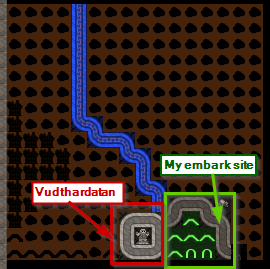
Once entering the game in Fortress Mode, I realized right away that the game was not going to let me embark on the site of the old fortress. The best I could do was take a spot right next to it. Any hope for an interesting story will be that Siga comes out and attacks me at some point, which should be fun.
Darn

Darn

Of course, it’s a cold, and somewhat barren place, which means my dwarves may not survive the winter. Luckilly there’s a tiny bit of a temperate biome nearby, so my site might have a few trees, a few plants, and maybe even part of that brook, if it isn’t frozen over. The elevation looks varied, which is always more interesting than flat.
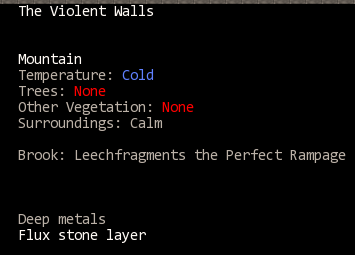
embark_stats

Brrr

I was surprised that the game gave me 6 females and 1 male; great story fodder. I looked at the randomly created dwarves and tried to give the skills I needed to the dwarves best suited for them (my miner should be someone who doesn’t tire easily, etc). I gave the male all the traits I thought would have made him the expedition leader, because he’s the “hero” of my story. I’m kind of glad I made a mistake, because the story is more interesting that he isn’t the leader. Turns out that the “Judge of Intent” trait I gave the hunter made her the Leader. Interesting.

Another mistake I made was hitting the ‘e’ key accidentally (Embark!); thus the game started before I was able to make sure I had all the right supplies for the situation (hence, why in the story Stakud and Lokum fought over the anvil). Also, because of that ‘e’ stroke, I didn’t get to see what the random name of my Group or my Fortress was. Getting the Fortress name is easy (it’s right there in the next screen), but my Group name apparently only shows up when I engrave walls. So we’ll see if Stakud truly is inspired to engrave something cool. I’ll just fill in the Group Name to my story later when I find it.

When the actual game loaded up, there was my team on the cliffs, snow and silt everywhere, and a handful of trees. The brook looks to be only be a few frozen ponds. These will probably be murky pools once the thaw comes, but that remains to be seen. If so, my cistern plan will need to involve a pump, to “cleanse” the water. I look at what’s in the wagon, and I think I made as good a selection as any. There’s platinum in plain view, but I’m afraid to mine it yet, lest it increase my wealth value too quickly and bring a goblin ambush. I see right away where I want to start the digging.

Let’s strike the earth!
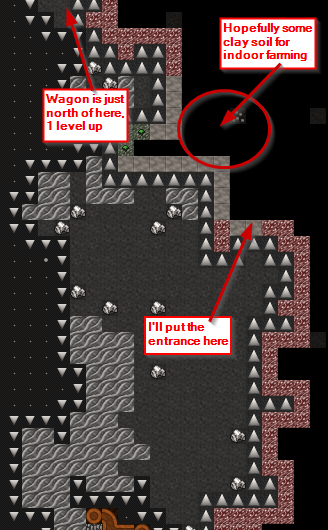
embark2

A plan forms…

Gameplay breakdown continues here.

Ransackediron Restored, Part 1: A Dwarf Fortress Story

← Read the introduction

15th day of Malachite, 550 years since the Record began,

Stakud “Closebolt” Urolalath, Mason and Bookkeeper for the Expedition Group Anuzlolor, “The Fair Letter”

After weeks of travel, we’ve finally arrived at the site of our future – and final – home. For our first night we’ve chosen a small cove in the Hill of Mobbing, overlooking a frozen brook strangely called Leechfragments the Perfect Rampage. Although it is early spring, you would never know it in this place. It is COLD, and snow covers nearly everything we see. I fear that “thaw” is a word rarely spoken in these lands, and I seriously doubt this brook will be rampaging any time soon. We must all work quickly to gather whatever edible plants and animals survive here, or we will surely starve. The two draft animals served us well pulling the wagon, but they will likely be slaughtered within days, for there is nowhere for them to graze; I’ve never eaten camel before. (WHY did we bring a camel??)

The women grumble under their breath, but I hear them. They wish they hadn’t come. I realize the situation is bleak, and but for a moment I too wonder what we’re doing here. Then, atop this precipice where I write, I peer to the west, and I can see it: the ruins of the ancient stronghold, hollowed out of a southern point of The Violent Walls mountain range. The fulfillment of my destiny is almost within my grasp! Vudthardatan, called “Ransackediron” in the Humans’ crude tongue, lies before me, the first fortress ever constructed by my glorious civilization Nidostdegel, “The Ferocious Galley.” It was a small band of dwarves calling themselves The Tired Arrow who struck the earth here, and on that day our realm started and the Record began. For the next twenty eight years my ancestors flourished in the city, until it was laid waste in the Rampage of Siga Gravefatal, the Shadow-shaft of Caves. That great beast, forgotten for over 500 years, has slumbered there ever since, burrowed deep in the bowels of the fortress, and none have dared approach its crumbled walls.

Until now.

Siga has appeared in my dreams more times than I can count, and each time I slew him with an axe cast in the heat of the same magma sea that once fired the ancient forges of Vudthardatan. But these are not just dreams, they are visions, sent to me from Rimtar god of Fortresses, for I am destined to reclaim our very first home! Alas, only a scant few believe in me, so I don’t have the force with which to launch an assault yet. Thus my small band of loyal followers and I will create an outpost here, and grow stronger, perhaps drawing more support once others realize we are called to greatness. Maybe even Siga himself will see our might from his lair deep below, and emerge on his own to try to thwart our plans before they can come to fruition. I say let him! I will meet him on the battlefield and take off his head just as I have dozens of times before! This truly is the Age of Heroes, and I intend to carve my name in its Memorial Wall of Legends!

Back home they laughed at me – all of them. Not a single male would join my cause. So be it. I brought with me six strong she-dwarves, and together we will vanquish the foe and restore glory to Vudthardatan.

Stodir, our eldest and strongest, is ready to strike the earth for the cause, but she believes she saw platinum in the mountains here. I’ve told her to wait its extraction, lest we draw the attention of marauding kobolds and goblins. There will be plenty of time to flaunt our wealth once we have settled in. In the meantime, I have sketched out a plan for her to mine out a small area of the hill for a temporary dwelling until the summer. Then we begin work on a water cistern deep below the ground where we can keep it from freezing – and so that we do not die of thirst.

We brought with us dogs that we could train as basic guards, but the crafter Adil has offered to take measures to automate our protection from intruders with elaborate traps she has personally designed. I hope she finds the proper stones for which to carve the mechanisms she needs to accomplish this.

Edem is a skilled woodsmith, but I fear she will be bored from the lack of trees here. Perhaps we will find some cavern-dwelling fungiwood for her to fell. As a last resort, there is always the elves who could trade their lumber with us, but let us pray it doesn’t come to that…

Ushat our Farmer has brought seeds to start cave plants for our underground farm, but I hope we can find more surface crops to harvest during a thaw. I would rather brew plump helmet mushrooms into a fine drink than eat them.

Olin, ever faithful friend, will cook and brew our crops for us until they run out. May that day never come, for her Dwarven Wine is like no other. Hopefully we can find game about these mountains to sustain us with meat and fill our bellies with Olin’s wonderful stews.

Which brings me to Lokum, our hunter, who usurped me and became Expedition Leader on the day we embarked. As adequate as she may be, I do doubt her abilities to guide us any further now that we are here. Already I’ve chastised her for bringing the anvil instead of more food. (I hadn’t noticed it in the wagon all this time.) We argued in front of everyone: she saying the anvil will be needed for the future smith, I saying meat first, she countering with her hunting skills… it went on for a long time. In the end, I accused her of ignoring my wishes from the supply list; she could only feebly claim they all thought I was dead on the day we left, which is why they packed and left without me. Ridiculous, of course, for everyone knows I am a deep sleeper. I believe they wish to create a name for she-dwarfkind by taking my destiny away from me and basking in it themselves. I will be watching them all, but Lokum the closest.

So of the seven of us, that leaves myself, Stakud, who will carve the stone for the glory of this place. The women have allowed me to name it Cilobaval, “Roofloves,” in honor of my long departed wife. I feel as if she is with me already. Tonight I will engrave images into our first mined wall to spur the hopes of us all. May Rimtar inspire me as I work the rock.

And Siga, take heed: your days are now numbered.

Atop the Hill of Mobbing

Atop the Hill of Mobbing

The story continues in part 2.

For a breakdown of the actual gameplay, read on here.

If you enjoyed this, perhaps you might enjoy my original novel, By the Light of the Moons, available for download on Amazon Kindle.

Dwarf Fortress: A Story-Maker

(This is just an introduction – if you want to jump right into the story, it starts in Part 1!)

“The Weretortoise Thabi Bithardolil has come! A large tortoise twisted into humanoid form. It is crazed for blood and flesh. Its eyes glow chartreuse. Its black scales are jagged and overlapping. Now you will know why you fear the night.”
-An actual quote from one of my Dwarf Fortress sessions

Thabi the Weretortoise sounded a lot scarier than it was. He was also slow.

Thabi the Weretortoise sounded a lot scarier than it was. He was also slow.


“His leisure activities are more complicated than most people’s jobs.”
– My wife Bethany, when describing me.

My wife’s quote above is a completely accurate statement about me; I love complicated hobbies, and Dwarf Fortress is an immensely complicated computer game that I love to play. Lately I’ve been binging on it, and I’ve been neglecting my writing. So, I decided to have some fun and flex the old writing muscles by putting the two together. Today begins a blog series where I will play the computer game Dwarf Fortress and create an epic story from what occurs during the game. Everything you read will be actual events that occur in the game, from the perspective of the dwarves, followed by a more geeky explanation of what transpired during that game session. I know I’m not the first person to do this, but I still hope you enjoy it.

If you follow the indie computer game market, chances are you’ve heard of Dwarf Fortress; this post is just an introduction to the game itself, so if you’re already familiar with the game, you can skip ahead to Part 1. For the uninitiated, sit back and get ready to have your mind blown as I introduce the basic concepts of the game today.

Dwarf Fortress is one of the most complex video games ever created (so agrees the author of the strategy guide you can buy from O’Reilly press). It’s programmed by one man, Tarn Adams, and he has been working on it for 12 years; it has been in players’ hands for the last 8. This past July, Dwarf Fortress released version .40, which means that the developer considers this game to be about 40% complete. The game is classified as being in the alpha stage of development, which supposed to be a stage so riddled with bugs and application crashes that most people are never allowed to see it. A beta version, which is an almost-final version looking for that last coat of polish, is likely a decade or two away. The game is free to download and play, in it’s (incomplete) entirety, and yet Adams does the unthinkable: he works on this game as his full time job. How does he feed himself and otherwise make a living? Through the generous donations of his loyal, somewhat fanatical, fanbase. He is living the dream a majority of indie game developers will never experience.

If that’s not impressive, take a look at what people are shelling out their money for:

Who needs graphics when you can have THIS?

Who needs graphics when you can have THIS?

Not very pretty looking, is it? And yet he makes $50,000 a year coding this game. FOR THAT? Is he a genius or a snake oil salesman?

The former, I assure you.

“But what are we looking at?” you ask. Those are called ASCII text characters, reminiscent of 1980’s style computer games before graphics really existed and were otherwise “required” for games. That’s just a static image above, of course; in the actual game, a lot of those letters and symbols move around because they represent things: people, creatures, leaves; some stay put because they are stones, walls, doors, etc. Here’s an annotated version of that previous screenshot.

r = rabbit. Easy, right?

r = rabbit. Easy, right?

I’ll admit, this view is confusing even for me to look at. It reminds me of the Matrix (others think so too), and although I’ve tried to be a purist with the original graphics, I just can’t do it. Instead, I use fan-created graphics that replace the original, so that it is easier to play. How’s this one?

The difference is like night and ... later that night.

The difference is like night and … later that night.

Still confusing? Yeah, it is, but that’s a big hurdle we just got over.

So graphics aside, what is this game about, anyway? Well, it’s really whatever you want it to be, but the general gist is to take seven dwarves (ha!) that have just arrived at a site and make a home for them. The dwarves should, ideally, come prepared with some basic tools and food, and they each have their own skills, so it’s just a matter of getting them to do what they need to do to survive. The tricky part is that you don’t really control the dwarves themselves, you control the tasks you want completed. This means you designate areas to be worked, such as mining out a hole, planting crops, or chopping some trees; or you might tell the dwarves you want a carpenter’s workshop built in a certain location, and later, tell that workshop to start making some wooden barrels to store supplies in. Ultimately, they will do all this stuff when they good and well feel like it. As your dwelling grows, you’ll get some migrants who’ll want to join you, your dwarves will pair off and make dwarf babies, and some will die due to old age or, more likely, tragic reasons. There’s never a dull moment.

Part life simulation, part city simulation, part strategy, part story-telling, part … it’s hard to classify the game, really. But where the game really shines is the amount of detail that goes into just about everything (and I mean everything). Here’s but a sample:

  • Your dwarves live in a randomly created world that will never be the same as the next world created by you or anyone else.
  • The world has hundreds of thousands of details: creatures, plants, mountain ranges, bodies of water, climate, biomes, ruins, roads, and cities and towns
  • Most of those details are named, right down to brooks and streams
  • The world has an actual historical record of events going back hundreds of years that you can read about. Events that take place in your game become part of that history
  • Although the top-down view of the game looks 2-dimensional, it’s really 3-dimensional; in addition to moving the screen left, right, up and down, you also can move it higher or lower, so you can see the dwarves and creatures move up and down hills, fall off cliffs, etc.
  • Creatures are modeled down to the finger and toe. Your dwarves that get in a fight with a crocodile might lose a finger or two, and their overall work productivity will forever suffer from it. (Oh, and clothing is down to the sock.)
  • Dwarves have likes, dislikes, have goals and dreams, can be bothered, annoyed, frightened, and even sent into a table-smashing tantrum.
  • Some games might allow you to “make clothing” and that’s it. Dwarf Fortress lets you makes you take a seed and plant it; once grown, take that crop and thresh it to make thread; take the thread to the loom and spin it into cloth; take the cloth and dye it a color; take the dyed cloth and make a piece of clothing. Like a sock. Do it all again to make the other sock. You can make them more valuable socks if you embroider them. Dwarves like valuable things, even socks, and get happy from it. Happy dwarves are less likely to smash tables. Less likely.

One last thing to always keep in mind – and this bothers a lot of people – is that, in the end, you will lose. It’s pretty much inevitable. Whether you run out of food (or worse, booze – dwarves need alcohol) and starve, or get smashed by a goblin army and their troll sidekicks, or you dig into an aquifer and flood the whole fortress, or you dig too deep and too greedily and find shadow and flame, eventually, you will lose.

So what’s the point?

Because losing is fun.

And that fun makes great stories.

The story begins in Part 1.

How I Wrote a Novel, Part Five

(continued from part one, part two, part three, and part four)

This is the final part of my series, and it concerns the revision phase.

Once I knew I was going to finish the initial draft of my novel, I also knew there would be many more drafts to follow. It wasn’t just because everything I read about writing said this would happen. I knew it instinctively, because I know myself – perfectionistic, detail-oriented, I couldn’t rest with just one pass through. On the other hand, I also had to limit myself, because I knew I could probably keep going and going and drive myself crazy.

Thus, my plan had always been:

  • Draft 1: The initial draft, get the story out on the screen and finish it
  • Draft 2: Make the story cohesive, thematic, consistent; cut what no longer fits (think: 20 grit sandpaper)
  • Draft 3: Polish the prose; read the story in one sitting to create a proper flow
  • Beta reader phase: let friends and family read the whole thing and offer constructive criticism
  • Final Draft: Incorporate suggestions I agree with from beta reader phase.

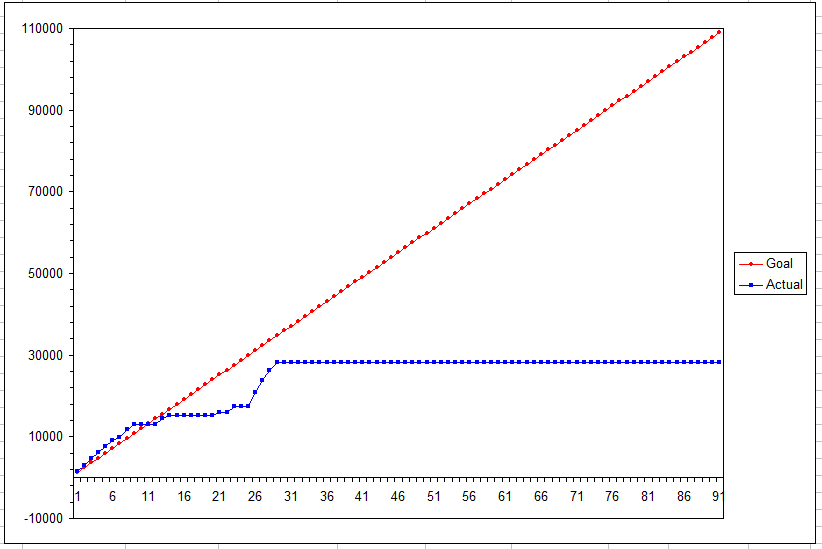
And that is pretty much just how it has happened. Draft 2 was very difficult for me. I had hoped to finish all the above in three months’ time. Here is how Draft 2 worked out over those 3 months:

Poor motivation to revise

Yep, failed again. I chickened out on stickk this time, so maybe that had a part to play in it. Since the first half of the book was so different from the second half, I had to reread carefully to make sure I got rid of the old thematic stuff and seeded with new thematic stuff as I went along. I also kept Stephen King’s suggestion in the back of my head: “2nd draft = 1st draft minus 10%”. In the end, draft 2 was exactly that.

But how did I do that? Well, it was my son. You see, today is his due date; we’re expecting him to be born any day now. And I wanted to get draft 3 done and in the hands of beta readers before he was born. Then that would give them all a month or so to read it, and I could spend time with my family. I finally had the motivation I needed for the last big push. January was the hardest, getting through 3/4 of the book in one month.

Now THAT's revising!

Success, draft 2 was complete, and it was 10% smaller. And yet it really wasn’t as hard as I thought it would be. Not trying to sound arrogant here, honestly, but the evidence is clear: I am capable of doing quite a lot when properly motivated. So I re-learned something about myself these last 16 months: with the pressure of a definitive goal I can do great things. (Let’s see if I can solidify that in my mind and finish the next book, start to finish, in half that time.)

The first weekend in February I printed all 350 pages and read the whole thing in one sitting with a red pen in hand. Took another 2 weeks to put those edits in, and it got smaller still. Draft 1 was 109,000 words, Draft 3 was 96,000. During the last week of February I formatted everything and sent it out to the beta readers before March 1. And that is where it stands now.

So there you have it, how I wrote a novel in 16 months. Hopefully you yourself will be able to read it soon. I’m really considering ebook self-publishing, despite the prestige a “real” published work could bring. The always controversial Joe Konrath has some pretty convincing advice about this, so I’ll have to see what my beta-readers think. However I publish – and I WILL PUBLISH – I’ll be sure to let you watch the journey right here.

I hope you don’t feel cheated now that you’ve reached the end of the series. After all, the series was called “How I Wrote a Novel”, not how I published one. But I’m just as interested in that part of the story as you are. Stick around and watch me do it.

How I Wrote a Novel, Part Four

(continued from part one, part two, and part three)

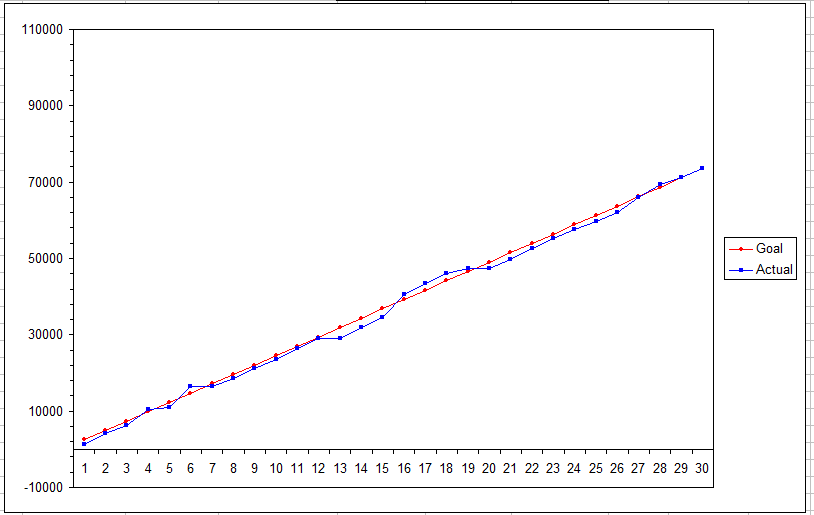
Before talking about the revision period, I wanted to get into a little more detail of how I finished the second half of my book. One of the things that I struggled with after the big marathon was finding the proper motivation. What, finishing the novel wasn’t enough? Apparently not. Watching my chart during November, knowing I was getting closer and closer to 50,000 words with each passing day, was a great motivator. But come January, the motivation was gone.

What was the problem? Well, burn out for starters, as can be expected. But after taking December off, that wasn’t an excuse anymore. Next problem? Well, there was the fact that I wasn’t really sure how long this thing was going to get. 100,000 words? 150,000 words? And how long would I take to finish it? Another marathon month? Two?

I figured I needed another nerdy chart to watch my progress, but with a wife and one year old at home, I didn’t want to put them through another crazy month. So I came up with a goal of another 50,000 words by the end of March. 50,000 words in THREE months? That meant I only had to work 1/3 as hard as last time! Easy!

Nope. By February I saw the goal slipping so I moved the end date to the end of April. Result:

Goal unmet

Pathetic. But you’ll notice I picked up some steam at the end there. What happened?

stickk happened.

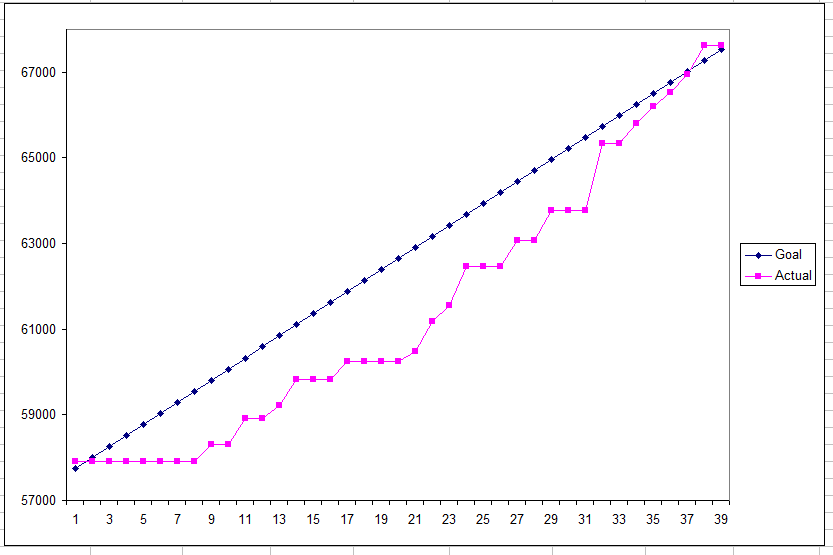
I would not have started a novel without NaNoWriMo, but I would not have finished my novel if it weren’t for stickk. I highly recommend stickk for anyone who wants to “stick to a goal” (get it?). I chose a method that worked very well for me, and I called it negative reinforcement. I set a goal of 10,000 words from the last week of March to the end of April, 39 days. I gave stickk my credit card number. I authorized them to take $10 of my hard earned money and give it to an ANTI-charity (a politcal organization I was opposed to) if I didn’t meet my goal. You can set up a referee to tell stickk you stuck to the goal, but I chose the honor system. I WAS HONORABLE.

And it worked. Here’s a better view of late March and early April:

Much better

I still floundered a bit there. That was because the goal was so small (250 words a day). I needed a little more to keep the pressure on. For May, the goal was 12,379 words to get up to an even 80,000. June was 15,000 more words. That was a busy month and I was scared I wouldn’t make it, so July was back to the easier 10,000. For August I just needed a little more time to finish it up. I finished on August 8, 2011.

Every month I wagered $10 or $15 that could have gone to “the evil charity” if I didn’t meet my goal. And I was dead set on making sure they never got any of my money. They never did.

So I had finished a novel in less than a year, pretty cool. Except, as I said in part three, the two halves of the novel were very different. So really, I hadn’t finished at all. I was again only half-done. It was revision time.

Concluded in part five