Ransackediron Restored, Part 1: A Dwarf Fortress Story

← Read the introduction

15th day of Malachite, 550 years since the Record began,

Stakud “Closebolt” Urolalath, Mason and Bookkeeper for the Expedition Group Anuzlolor, “The Fair Letter”

After weeks of travel, we’ve finally arrived at the site of our future – and final – home. For our first night we’ve chosen a small cove in the Hill of Mobbing, overlooking a frozen brook strangely called Leechfragments the Perfect Rampage. Although it is early spring, you would never know it in this place. It is COLD, and snow covers nearly everything we see. I fear that “thaw” is a word rarely spoken in these lands, and I seriously doubt this brook will be rampaging any time soon. We must all work quickly to gather whatever edible plants and animals survive here, or we will surely starve. The two draft animals served us well pulling the wagon, but they will likely be slaughtered within days, for there is nowhere for them to graze; I’ve never eaten camel before. (WHY did we bring a camel??)

The women grumble under their breath, but I hear them. They wish they hadn’t come. I realize the situation is bleak, and but for a moment I too wonder what we’re doing here. Then, atop this precipice where I write, I peer to the west, and I can see it: the ruins of the ancient stronghold, hollowed out of a southern point of The Violent Walls mountain range. The fulfillment of my destiny is almost within my grasp! Vudthardatan, called “Ransackediron” in the Humans’ crude tongue, lies before me, the first fortress ever constructed by my glorious civilization Nidostdegel, “The Ferocious Galley.” It was a small band of dwarves calling themselves The Tired Arrow who struck the earth here, and on that day our realm started and the Record began. For the next twenty eight years my ancestors flourished in the city, until it was laid waste in the Rampage of Siga Gravefatal, the Shadow-shaft of Caves. That great beast, forgotten for over 500 years, has slumbered there ever since, burrowed deep in the bowels of the fortress, and none have dared approach its crumbled walls.

Until now.

Siga has appeared in my dreams more times than I can count, and each time I slew him with an axe cast in the heat of the same magma sea that once fired the ancient forges of Vudthardatan. But these are not just dreams, they are visions, sent to me from Rimtar god of Fortresses, for I am destined to reclaim our very first home! Alas, only a scant few believe in me, so I don’t have the force with which to launch an assault yet. Thus my small band of loyal followers and I will create an outpost here, and grow stronger, perhaps drawing more support once others realize we are called to greatness. Maybe even Siga himself will see our might from his lair deep below, and emerge on his own to try to thwart our plans before they can come to fruition. I say let him! I will meet him on the battlefield and take off his head just as I have dozens of times before! This truly is the Age of Heroes, and I intend to carve my name in its Memorial Wall of Legends!

Back home they laughed at me – all of them. Not a single male would join my cause. So be it. I brought with me six strong she-dwarves, and together we will vanquish the foe and restore glory to Vudthardatan.

Stodir, our eldest and strongest, is ready to strike the earth for the cause, but she believes she saw platinum in the mountains here. I’ve told her to wait its extraction, lest we draw the attention of marauding kobolds and goblins. There will be plenty of time to flaunt our wealth once we have settled in. In the meantime, I have sketched out a plan for her to mine out a small area of the hill for a temporary dwelling until the summer. Then we begin work on a water cistern deep below the ground where we can keep it from freezing – and so that we do not die of thirst.

We brought with us dogs that we could train as basic guards, but the crafter Adil has offered to take measures to automate our protection from intruders with elaborate traps she has personally designed. I hope she finds the proper stones for which to carve the mechanisms she needs to accomplish this.

Edem is a skilled woodsmith, but I fear she will be bored from the lack of trees here. Perhaps we will find some cavern-dwelling fungiwood for her to fell. As a last resort, there is always the elves who could trade their lumber with us, but let us pray it doesn’t come to that…

Ushat our Farmer has brought seeds to start cave plants for our underground farm, but I hope we can find more surface crops to harvest during a thaw. I would rather brew plump helmet mushrooms into a fine drink than eat them.

Olin, ever faithful friend, will cook and brew our crops for us until they run out. May that day never come, for her Dwarven Wine is like no other. Hopefully we can find game about these mountains to sustain us with meat and fill our bellies with Olin’s wonderful stews.

Which brings me to Lokum, our hunter, who usurped me and became Expedition Leader on the day we embarked. As adequate as she may be, I do doubt her abilities to guide us any further now that we are here. Already I’ve chastised her for bringing the anvil instead of more food. (I hadn’t noticed it in the wagon all this time.) We argued in front of everyone: she saying the anvil will be needed for the future smith, I saying meat first, she countering with her hunting skills… it went on for a long time. In the end, I accused her of ignoring my wishes from the supply list; she could only feebly claim they all thought I was dead on the day we left, which is why they packed and left without me. Ridiculous, of course, for everyone knows I am a deep sleeper. I believe they wish to create a name for she-dwarfkind by taking my destiny away from me and basking in it themselves. I will be watching them all, but Lokum the closest.

So of the seven of us, that leaves myself, Stakud, who will carve the stone for the glory of this place. The women have allowed me to name it Cilobaval, “Roofloves,” in honor of my long departed wife. I feel as if she is with me already. Tonight I will engrave images into our first mined wall to spur the hopes of us all. May Rimtar inspire me as I work the rock.

And Siga, take heed: your days are now numbered.

Atop the Hill of Mobbing

Atop the Hill of Mobbing

The story continues in part 2.

For a breakdown of the actual gameplay, read on here.

If you enjoyed this, perhaps you might enjoy my original novel, By the Light of the Moons, available for download on Amazon Kindle.
How I Wrote a Novel, Part Five

(continued from part one, part two, part three, and part four)

This is the final part of my series, and it concerns the revision phase.

Once I knew I was going to finish the initial draft of my novel, I also knew there would be many more drafts to follow. It wasn’t just because everything I read about writing said this would happen. I knew it instinctively, because I know myself – perfectionistic, detail-oriented, I couldn’t rest with just one pass through. On the other hand, I also had to limit myself, because I knew I could probably keep going and going and drive myself crazy.

Thus, my plan had always been:

  • Draft 1: The initial draft, get the story out on the screen and finish it
  • Draft 2: Make the story cohesive, thematic, consistent; cut what no longer fits (think: 20 grit sandpaper)
  • Draft 3: Polish the prose; read the story in one sitting to create a proper flow
  • Beta reader phase: let friends and family read the whole thing and offer constructive criticism
  • Final Draft: Incorporate suggestions I agree with from beta reader phase.

And that is pretty much just how it has happened. Draft 2 was very difficult for me. I had hoped to finish all the above in three months’ time. Here is how Draft 2 worked out over those 3 months:

Poor motivation to revise

Yep, failed again. I chickened out on stickk this time, so maybe that had a part to play in it. Since the first half of the book was so different from the second half, I had to reread carefully to make sure I got rid of the old thematic stuff and seeded with new thematic stuff as I went along. I also kept Stephen King’s suggestion in the back of my head: “2nd draft = 1st draft minus 10%”. In the end, draft 2 was exactly that.

But how did I do that? Well, it was my son. You see, today is his due date; we’re expecting him to be born any day now. And I wanted to get draft 3 done and in the hands of beta readers before he was born. Then that would give them all a month or so to read it, and I could spend time with my family. I finally had the motivation I needed for the last big push. January was the hardest, getting through 3/4 of the book in one month.

Now THAT's revising!

Success, draft 2 was complete, and it was 10% smaller. And yet it really wasn’t as hard as I thought it would be. Not trying to sound arrogant here, honestly, but the evidence is clear: I am capable of doing quite a lot when properly motivated. So I re-learned something about myself these last 16 months: with the pressure of a definitive goal I can do great things. (Let’s see if I can solidify that in my mind and finish the next book, start to finish, in half that time.)

The first weekend in February I printed all 350 pages and read the whole thing in one sitting with a red pen in hand. Took another 2 weeks to put those edits in, and it got smaller still. Draft 1 was 109,000 words, Draft 3 was 96,000. During the last week of February I formatted everything and sent it out to the beta readers before March 1. And that is where it stands now.

So there you have it, how I wrote a novel in 16 months. Hopefully you yourself will be able to read it soon. I’m really considering ebook self-publishing, despite the prestige a “real” published work could bring. The always controversial Joe Konrath has some pretty convincing advice about this, so I’ll have to see what my beta-readers think. However I publish – and I WILL PUBLISH – I’ll be sure to let you watch the journey right here.

I hope you don’t feel cheated now that you’ve reached the end of the series. After all, the series was called “How I Wrote a Novel”, not how I published one. But I’m just as interested in that part of the story as you are. Stick around and watch me do it.

How I Wrote a Novel, Part Four

(continued from part one, part two, and part three)

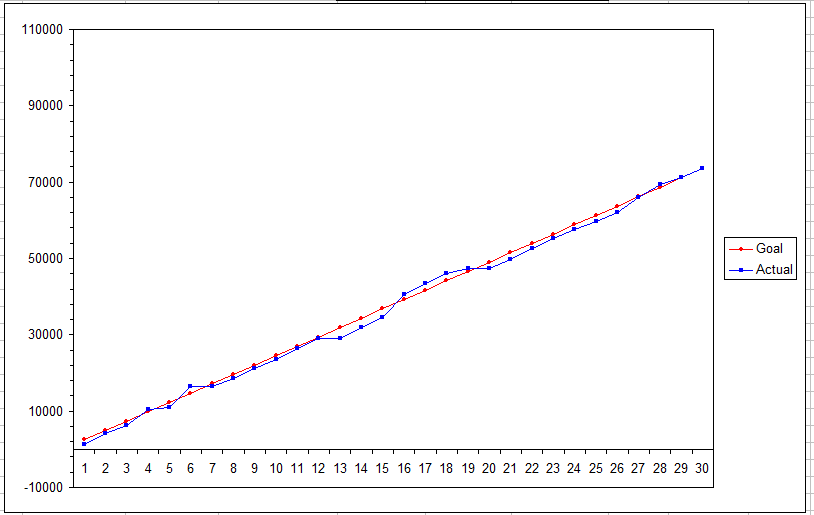
Before talking about the revision period, I wanted to get into a little more detail of how I finished the second half of my book. One of the things that I struggled with after the big marathon was finding the proper motivation. What, finishing the novel wasn’t enough? Apparently not. Watching my chart during November, knowing I was getting closer and closer to 50,000 words with each passing day, was a great motivator. But come January, the motivation was gone.

What was the problem? Well, burn out for starters, as can be expected. But after taking December off, that wasn’t an excuse anymore. Next problem? Well, there was the fact that I wasn’t really sure how long this thing was going to get. 100,000 words? 150,000 words? And how long would I take to finish it? Another marathon month? Two?

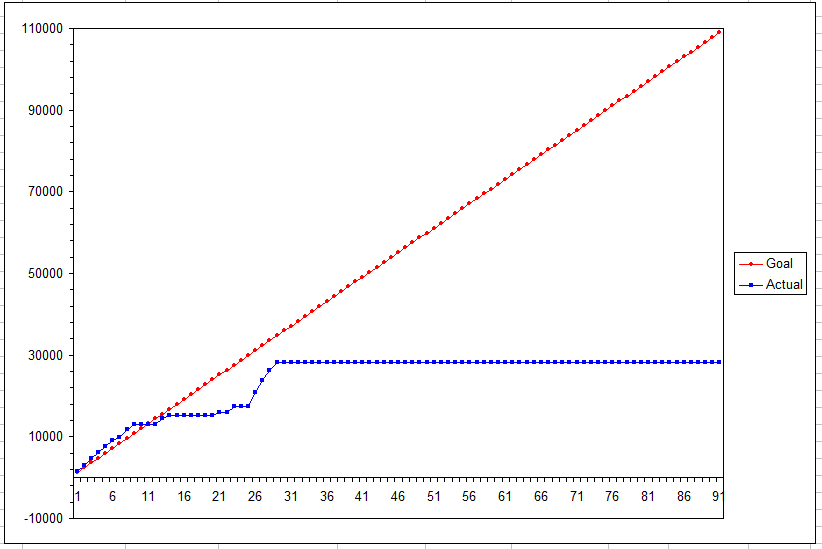
I figured I needed another nerdy chart to watch my progress, but with a wife and one year old at home, I didn’t want to put them through another crazy month. So I came up with a goal of another 50,000 words by the end of March. 50,000 words in THREE months? That meant I only had to work 1/3 as hard as last time! Easy!

Nope. By February I saw the goal slipping so I moved the end date to the end of April. Result:

Goal unmet

Pathetic. But you’ll notice I picked up some steam at the end there. What happened?

stickk happened.

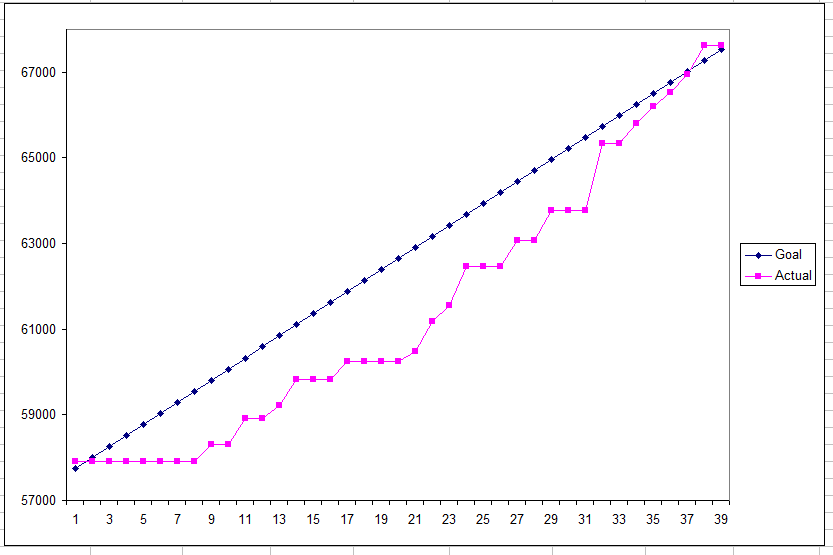
I would not have started a novel without NaNoWriMo, but I would not have finished my novel if it weren’t for stickk. I highly recommend stickk for anyone who wants to “stick to a goal” (get it?). I chose a method that worked very well for me, and I called it negative reinforcement. I set a goal of 10,000 words from the last week of March to the end of April, 39 days. I gave stickk my credit card number. I authorized them to take $10 of my hard earned money and give it to an ANTI-charity (a politcal organization I was opposed to) if I didn’t meet my goal. You can set up a referee to tell stickk you stuck to the goal, but I chose the honor system. I WAS HONORABLE.

And it worked. Here’s a better view of late March and early April:

Much better

I still floundered a bit there. That was because the goal was so small (250 words a day). I needed a little more to keep the pressure on. For May, the goal was 12,379 words to get up to an even 80,000. June was 15,000 more words. That was a busy month and I was scared I wouldn’t make it, so July was back to the easier 10,000. For August I just needed a little more time to finish it up. I finished on August 8, 2011.

Every month I wagered $10 or $15 that could have gone to “the evil charity” if I didn’t meet my goal. And I was dead set on making sure they never got any of my money. They never did.

So I had finished a novel in less than a year, pretty cool. Except, as I said in part three, the two halves of the novel were very different. So really, I hadn’t finished at all. I was again only half-done. It was revision time.

Concluded in part five

How I Wrote a Novel, Part Three

(continued from part one and part two)

So I had just finished writing half a novel in a month (50,000 words!), and after an honest critique I had to face an uncomfortable truth: it wasn’t really a novel.  I had a choice to make.  I could either wallow in self-pity, go back to making it a video game, or start educating myself on just what a novel really is.

After some wallowing, I decided I didn’t want this story to be a game.  I wanted it to be a book.  So the education began.

I’m a fairly adept writer.  I don’t say that to sound arrogant, I know I’m far from a great writer, but I also know that this is a talent I have had for a long time.  If you peruse my site, you’ll see I’ve been writing for over ten years.  Never published, mind you, but that’s only because I’ve never tried yet.  I’m man enough to admit when I don’t know something, though, and I was faced with something I did not know: what makes a novel good enough that people will buy it?

I’ll be creating a list of resources soon so that people can see all the things I’ve read up on over the last year.  For now, I’ll list just three things that had a major impact on shapping my novel’s story.

First, I had to boil the whole thing down to a protagonist who wants something, and give the story a theme.  My first attempt had a protagonist, sure, but he was just thrown into the middle of saving the world because I, the writer, made it happen that way.  Fine for a video game, not really believable for a novel.  So I searched my heart, decided on the “big picture” story I wanted to tell, and I found my theme.  From there, I used that theme to drive the motivations of my main character so that he had a reason for doing the things he did.  Every obstacle in his way equaled a scene of action, and those scenes together formed a plot.

Second, I had to structure that plot.  For this, I found the Ten Scene Tool from The Writer’s Little Helper to be an excellent resource.  The general idea of this tool is to create rising and falling tension, a point of no return, a climax and a resolution, and break them down into ten key scenes.  The novel only has ten scenes?  Of course not, but it has ten really important ones, and they form the skeleton of the story.  Everything else built around them, filled in the gaps so to speak.

Third, I needed some guidance from a master.  To that end, I read Stephen King’s On Writing.  I recommend this book to anyone who wants to write.  Not only is it an encouraging read, he is refreshingly honest about what it takes to write in a way that people like to read today.

As I said, there were a lot of things I looked at, but these three were essential.  Another final piece I found everywhere I searched was, “Finish it.”  I had to resist going back to the first half and begin editing.  I made myself write another 60,000 words before ever looking at the first 50,000 again.  It took me 8 months, but I’m glad I did that way.  Now I could look at my huge document and say, “alright, draft one is done.  I did it.  I really wrote a novel.”  It was a great accomplishment, and those of you who have done it know the feeling.

NOW, I had to piece together two halves of a book and make sure they told a coherent story.  Oh what fun.

…Continued in part four